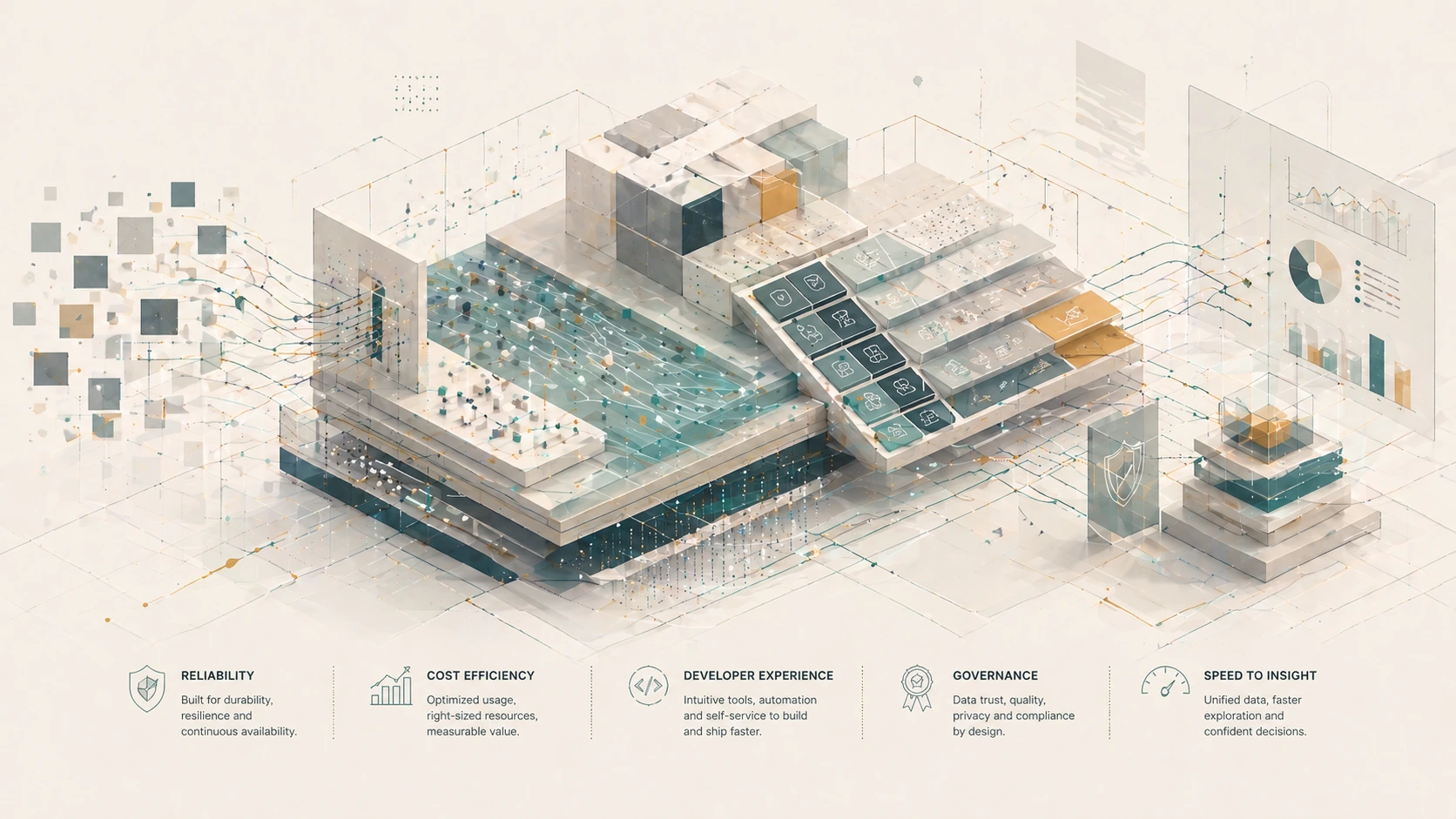
Most teams evaluating data platforms spend too much time debating tool choices and architecture patterns, and not enough time asking whether the platform actually works in practice. The conversation usually starts with "should we use Snowflake or Databricks?" or "do we need a lakehouse?" and quickly devolves into vendor comparisons and technology preferences. The real question should be: does this platform help teams produce trusted data quickly, operate reliably, manage cost responsibly, maintain good governance, and give developers a productive experience?
I've seen platforms with impressive architecture diagrams fail in production because teams couldn't use them effectively. I've also seen simple stacks succeed because they got the operating qualities right. A modern data platform is not defined by trendy tooling alone. It's defined by whether it helps teams deliver value reliably and sustainably.
What "modern" actually means
Modern does not automatically mean lakehouse, real-time everything, or AI-enabled dashboards. Modern means usable, trustworthy, adaptable, and operationally sound. A platform from 2015 can be modern if it meets these criteria. A platform built yesterday with the latest tools can be obsolete if it fails on these dimensions.
Usability means teams can actually use the platform without heroics. Trustworthiness means data consumers can rely on the outputs. Adaptability means the platform can evolve as needs change. Operational soundness means the team can run it reliably day after day. These are the qualities that matter, not whether you're using the newest technology.
Reliability
Reliability is foundational. A platform nobody trusts is not modern, no matter how advanced the stack is. Reliability means data freshness is predictable, pipelines are resilient, observability is comprehensive, incident response is systematic, and SLAs are meaningful. It means when something breaks, the team knows what happened and can fix it quickly.
I look for platforms where data freshness is measured and communicated, not hoped for. Where pipelines have retry logic, dead letter queues, and clear failure modes. Where observability goes beyond "did the job run?" to include data quality checks, volume anomalies, and performance metrics. Where incident response is a practiced process, not a scramble. Where SLAs reflect actual business needs, not arbitrary uptime targets.
The strongest signal of reliability is trust. When business users stop asking "is this data right?" and start asking "what does this data tell us?", you know reliability is working.
Cost
Cost discipline is a design principle, not an afterthought. Modern platforms should scale with intentional cost control, not surprise bills. I look for efficient pipelines that don't process more data than necessary, compute that's right-sized for actual workloads, storage hygiene that removes stale data, and minimal duplicated data movement.
The most common cost failures I see are overprovisioned compute sitting idle, expensive real-time pipelines for use cases that don't need them, and data lakes that become dumping grounds for everything. A modern platform makes costs visible and explainable. It should be easy to answer "what are we spending and why?" without running a complex analysis.
Cost optimisation isn't about being cheap. It's about spending money where it matters and eliminating waste where it doesn't. The best platforms I've seen treat cost as a first-class operational metric, alongside reliability and performance.
Developer experience
Platform adoption depends on developer experience. Bad developer experience turns a platform into a bottleneck. I look for clear interfaces that hide complexity without hiding capability, self-service workflows that don't require platform team intervention for every change, comprehensive documentation that answers real questions, fast feedback loops that let developers iterate quickly, and good local/dev/test environments that mirror production.
The worst platforms I've used were those where every change required a ticket, every deployment needed approval, and every question led to "ask the platform team." The best platforms were those where developers could ship changes safely and independently, with guardrails in place but not blocking progress.
Developer experience isn't about making things easy. It's about making the right things easy and the wrong things hard. A platform with great developer experience reduces friction for legitimate use cases while preventing dangerous mistakes.
Governance
Governance should be an enabler, not just a control layer. Modern governance makes trusted usage easier, not harder. I look for discoverability that lets people find the data they need, lineage that shows where data comes from and where it goes, ownership that's clear and accountable, quality expectations that are documented and enforced, access control that's granular and auditable, and standardisation that reduces cognitive load without eliminating flexibility.
The weakest governance I've seen was all control and no enablement - access requests took weeks, data definitions were inconsistent, and nobody knew who owned what. The strongest governance made it easy to do the right thing: data was discoverable, definitions were consistent, ownership was clear, and access was granted quickly to those who needed it.
Governance at its best is invisible. When data consumers can find what they need, understand what it means, and trust that it's accurate, governance is working. When they're constantly asking "who owns this?" or "is this the right table?", governance is failing.
Speed to insight
The platform exists to support decisions and action. Speed to insight matters, but only when paired with trust and clarity. I look for short time from raw data to usable insight, appropriate batch vs real-time trade-offs based on actual needs, semantic consistency that means the same metric has the same definition everywhere, and minimal handoffs between teams and systems.
The fastest platforms I've seen weren't necessarily the most real-time. They were the ones where data flowed smoothly from source to insight without unnecessary stops, where definitions were consistent across tools, and where consumers didn't have to reconcile conflicting versions of the same metric.
Speed without trust is useless. Speed without clarity is dangerous. The best platforms optimise for the time it takes to reach a trusted, actionable insight, not just the time it takes to move data from point A to point B.
How these dimensions interact
These dimensions are not isolated concerns. Optimising one without considering the others creates problems. Optimising speed without governance creates chaos - data moves fast but nobody trusts it. Optimising governance without developer experience creates avoidance - people build shadow systems because the platform is too hard to use. Optimising cost without reliability creates false savings -cheap compute that doesn't work is still expensive.
The best platforms balance these dimensions based on actual needs. A financial reporting system prioritises reliability and governance over speed. A customer analytics dashboard prioritises speed and developer experience over absolute cost control. A machine learning platform prioritises developer experience and adaptability over strict governance.
Platform judgment is about making these trade-offs explicitly and consistently, not about optimising everything at once. The teams that succeed are the ones that understand their priorities and design accordingly.
What I actually look for
When I evaluate a data platform, I look for specific signals that indicate whether these qualities are present in practice:
Teams trust the data. When business users rely on platform outputs without constant verification, reliability and governance are working. When they build downstream systems on top of platform data, that's the strongest validation.
Pipelines are observable. When the team can answer "what's running, what's broken, and why?" without digging through logs, observability is sufficient. When they can see data quality metrics alongside job status, that's even better.
Costs are explainable. When the team can break down spending by workload, user, or time period without running a complex analysis, cost discipline is present. When they can identify the top cost drivers and justify them, that's ideal.
New use cases don't require heroics. When a team can onboard a new data source or build a new dashboard without extensive platform team involvement, developer experience and self-service are working. When the same patterns work for the tenth use case as the first, that's scalability.
Governance is visible and usable. When data consumers can find what they need, understand ownership, and request access through a clear process, governance is enabling rather than blocking. When definitions are consistent and lineage is traceable, that's strong governance.
Engineers can ship changes safely. When developers can deploy code changes, test them in realistic environments, and roll back if something breaks, developer experience and reliability are aligned. When the platform provides guardrails rather than roadblocks, that's good design.
Business users get answers without reinventing definitions. When the same metric means the same thing across dashboards, reports, and ad-hoc analysis, semantic consistency is working. When business users can answer questions using existing data rather than building their own extracts, that's success.
Common mistakes
The most common mistake is chasing trendy architecture before fixing basics. Teams adopt lakehouses because they're modern, then struggle with the operational complexity. Others implement real-time pipelines for use cases that don't need them, then wonder why costs are high and reliability is low. The right choice depends on what you're trying to build, not what's trending.
Another mistake is overengineering for hypothetical scale. Many teams build platforms designed for 10x their current needs, then find that the complexity makes it hard to operate at 1x. Start simple, validate assumptions, and scale complexity only when justified by actual requirements.
Treating governance as a compliance afterthought is equally damaging. Teams focus on shipping data first and add governance later, then find themselves dealing with inconsistent definitions, unclear ownership, and access control nightmares. Governance should be designed in from the start, not bolted on after the fact.
Building a platform that only platform engineers can use is a recipe for failure. When every change requires platform team intervention, when documentation is written for other platform engineers rather than data consumers, when self-service is nonexistent, adoption will suffer. The best platforms are designed for their users, not their builders.
Finally, optimising for tool sophistication instead of decision impact is a subtle but dangerous mistake. Teams get excited about using the latest technologies, then lose sight of whether the platform actually helps the business make better decisions. The ultimate measure of a data platform is not how sophisticated it is, but how much value it delivers.
In short
A modern data platform is defined by operating qualities, not architecture diagrams or tool choices. Reliability, cost discipline, developer experience, governance, and speed to insight are the dimensions that matter. The best platforms balance these based on actual needs, make trade-offs explicitly, and focus on enabling teams to deliver value rather than chasing trends.
When evaluating a platform, look for trust in the data, explainable costs, usable governance, and productive developer experience. Look for whether new use cases require heroics or follow established patterns. Look for whether business users get answers from the platform or build their own shadow systems.
The goal is not to build the most sophisticated platform possible. The goal is to build a platform that helps teams produce trusted data quickly, operate reliably, manage cost responsibly, maintain good governance, and give developers a productive experience. Everything else is noise.