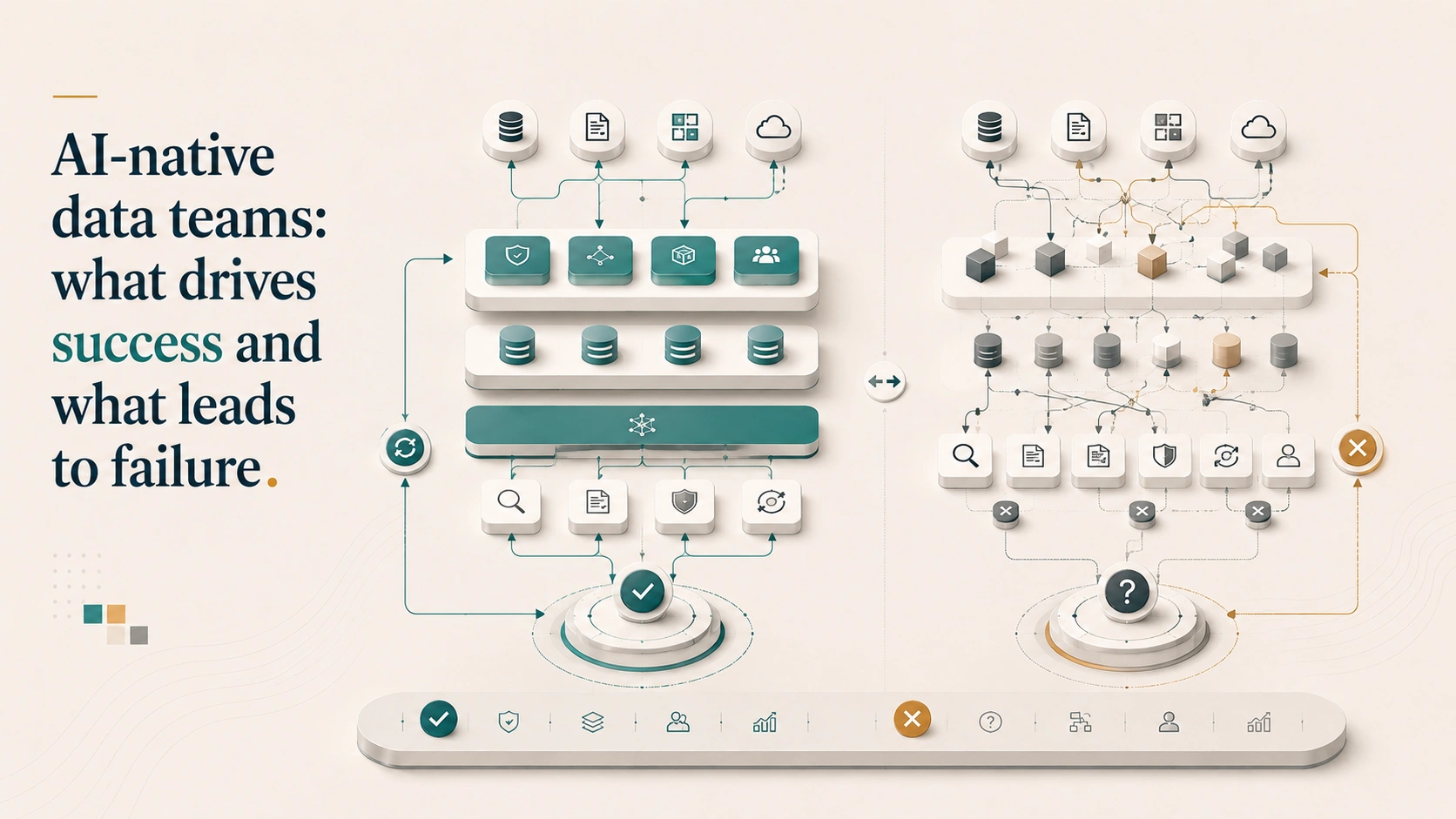
AI is a mirror, not an equaliser. It does not fix a team with weak foundations. It reflects what is already there and makes it louder. Teams with strong data cultures, clear ownership, and disciplined delivery see AI compound their advantages. Teams without those things see AI accelerate their dysfunction - more pipelines, more quality issues, more governance blind spots, all amplified by the speed of autonomous execution.
The data on AI's differential impact in engineering is instructive - senior practitioners realise far greater productivity gains than junior ones, not because they use AI better, but because they have the judgment to know what good looks like and the discipline to correct what does not meet the bar. The same pattern holds in data. Teams that already invest in governance, quality, and context are the ones getting durable value from AI-native approaches. Teams that treat AI as a shortcut around those investments are discovering it simply makes their existing problems louder.
What "AI-native" actually means in practice
An AI-native data team is one where the presence of AI has changed how data flows, who owns what, what reliability looks like, and how governance operates. It is not a team that uses AI tools. It is a team whose operating model has been redesigned around AI as a first-class consumer of data, sitting alongside analytics and ML.
In traditional data teams, the primary consumers are humans. Reports and dashboards are designed for people who can notice when something looks wrong and ask follow-ups. An AI agent that executes on stale data does not pause. It executes with full confidence and amplifies the error across every downstream system. This changes the data quality bar from "good enough for a human to catch issues" to "correct enough for a machine to act on without supervision."
This shift ripples through everything. Data contracts go from nice-to-have documentation to load-bearing infrastructure. Freshness SLAs become runtime constraints. Ownership moves from "who knows about this table" to "who gets paged when it goes stale." Feedback loops that were implicit become explicit instrumentation requirements. If none of this has changed in your team, you have not gone AI-native. You have just added AI.
The formula: Judgment × Discipline × Leverage
The organisations genuinely delivering value with AI-native data teams share patterns that cluster into three multiplicative factors. None works in isolation. All three must be present.
Judgment-knowing what to build and what quality to expect. The scarcest skill when code and pipeline generation are nearly free is deciding which AI use cases are worth pursuing, what constitutes good enough data quality, and when to say no to a new experiment. The best teams pick three to five high-impact use cases, build shared foundations, and expand methodically. They kill projects that are not delivering instead of letting them accumulate. They understand that not all data deserves the same rigor-transactional data feeding an autonomous agent needs stricter quality gates than a one-time analytics query feeding a human report. Judgment means matching the quality bar to the risk - strict where it matters, relaxed where it doesn't.
Discipline-the operating practices that prevent AI from amplifying chaos. Discipline is what separates teams that ship reliable AI from teams that ship confident wrong answers. It looks like data contracts with explicit ownership and freshness SLAs before agents are deployed. Automated quality gates at ingestion that catch schema drift and null thresholds. Governance embedded into data flows rather than bolted on after the fact-attribute-based access controls, audit trails for every decision step, lineage tracking that makes every AI output traceable to its source. Continuous evaluation, not a pre-deployment checkbox. Specs before prompts, tests before shipping, reviews before merging. Teams that skip these steps are the ones reporting production disasters from AI-generated pipelines.
Leverage-shared infrastructure that compounds across use cases. The highest-leverage teams invest in reusable context and retrieval layers instead of letting every agent build its own tailored pipeline. Business metric definitions, entity resolution logic, embedding indexes, and semantic definitions are maintained centrally and reused. Cross-functional pods replace sequential handoffs - data engineers, ML engineers, platform, and product build together rather than throwing work over walls. Shared infrastructure - ingestion templates, feature stores, eval harnesses, monitoring dashboards - makes it cheap to spin up new use cases and expensive to build one-off pipelines. Each new agent starts with more context, not from zero.
Success vs. Failure: Operating Patterns in Contrast
Side by side, the difference is unmistakable. Success is not about doing more - it is about doing the right things with the right foundations.
Shared context layers vs. Tailored pipelines for every agent. Shared context compounds across use cases - business metrics, embeddings, and semantic definitions maintained once, reused everywhere. Each new agent ships faster because it inherits context from previous work.
The failure case is every agent building its own pipeline from scratch: duplicate effort, fragmented knowledge, no compounding effect. That impressive demo dies because there is no shared infrastructure to productionise it.
Explicit data contracts vs. Silent schema changes that break AI. Every dataset consumed by an AI system has an explicit owner with documented freshness SLAs, quality expectations, and semantic definitions. When a source changes, the contract violation is detected before the agent fails.
The failure case is deploying AI on data you do not trust - no catalog, no lineage, no quality metrics. Schema changes ripple through AI systems undetected until downstream failures surface.
Governance embedded in data flows vs. Governance as a post-hoc audit exercise. Attribute-based access controls ensure agents operate within the same permissions as the human they represent. Audit trails capture every decision step. Governance enables rather than blocks.
The failure case is broad table grants because proper controls take too long - nobody can audit what the agent accessed or acted on.
Continuous evaluation vs. Validate once, then hope for the best. Retrieval accuracy is monitored. Hallucination rates are tracked. Human feedback is collected and corrections feed back into the system.
The failure case is checking model outputs before deployment and never looking again - data drift, schema changes, and concept drift compound silently until customer complaints force a retroactive fix.
Cross-functional pods vs. Sequential handoffs between teams. Data engineering, ML engineering, platform, and product build together with shared ownership of outcomes.
The failure case is sequential handoffs - one team builds pipelines and throws them over the wall, the next inherits work with incomplete context. When something breaks, nobody agrees who is responsible.
Disciplined attrition vs. A pipeline clogged with zombie projects. Pick three to five high-impact use cases, build shared foundations, expand methodically. Kill what does not deliver.
The failure case is chasing trends instead of solving specific problems - deploying expensive infrastructure in search of a use case, mistaking demos for production capability, and letting experiments pile up because nobody has the mandate to stop them.
Cycle time and impact vs. Output velocity and story points. Measure what reaches production and what it achieves.
The failure case is tracking pipelines built, models deployed, experiments launched - busyness mistaken for progress when AI makes creation cheap.
Rethink traditional data practices for AI-native work
A few inherited practices become counterproductive in an AI-augmented data team.
Not all data quality deserves the same severity. The traditional approach subjects every dataset to the same quality bar. In an AI-native world, tiering matters. Data feeding an autonomous agent that touches customer transactions needs strict quality gates, fresh SLAs, and full lineage. A one-time analytics view for a human report can tolerate more ambiguity - the human will catch anomalies. Apply severity proportional to consequence.
DRY for data pipelines needs recalibration. Avoid duplicating business logic across pipelines - that still creates drift. But it is often better to let two agents each build a simple retrieval pattern than to force them both through an inflexible shared abstraction. Duplicate consciously, with visibility, not by default.
Cycle time over project completion as the metric that matters. Output velocity - number of pipelines built, models deployed, experiments launched are misleading when AI makes creation cheap. The signal is cycle time from idea to production value, and lead time from request to reliable capability. Measure what reaches production and what it achieves, not how much is being built.
A practical framework for assessment
Leaders can use these questions to gauge whether their AI-native effort is on solid ground:
- Can teams reuse data and context across AI use cases, or is everything rebuilt from scratch for each agent? (Leverage)
- Are ownership and SLAs clearly defined for every dataset that feeds an AI system? (Discipline)
- Do you monitor AI outputs in production and have feedback loops that drive corrections? (Discipline)
- Are AI experiments tied to specific business problems with clear success criteria? (Judgment)
- Do access controls extend to AI systems - vector stores, embedding pipelines, agent permissions? (Discipline)
- Are teams overloaded with one-off experiments, or are they building shared, reusable patterns? (Leverage)
- Has the operating model changed since AI was introduced, or are you running the same playbook? (All three)
If the answer to most of these is "no," the foundations are not ready for AI at scale, regardless of how capable the models are.
Recommended next steps
For leaders looking to move in the right direction, these are the highest leverage investments:
Invest in governance and catalog before scaling AI applications. Automated quality gates, lineage tracking, and access controls are prerequisites for reliable AI, not luxuries for later. (Discipline)
Standardise data and context retrieval patterns. Shared context layers, centralised metric definitions, and reusable embedding pipelines reduce duplication and improve reliability. (Leverage)
Define clear ownership and SLAs for AI-related data. Every dataset an agent touches needs an accountable owner with explicit commitments on freshness, quality, and schema stability. (Discipline)
Build a small set of reusable patterns instead of endless one-off experiments. Templates for ingestion, retrieval, evaluation, and monitoring make it cheap to start new use cases and safe to operate them. (Leverage)
Start monitoring AI outputs and drift continuously. Treat evaluation as an ongoing operational practice. If you cannot measure whether quality is degrading, you cannot manage it. (Discipline)
Review and adjust the operating model explicitly. Ask honestly whether your team structure, governance processes, delivery rhythms, and success metrics have changed since AI became a priority. If they have not, start there. (Judgment)
In short
AI is a mirror, not an equaliser. It amplifies whatever foundations you have built. Teams with judgment, discipline, and leverage see AI compound their advantages, producing more reliable capability with fewer people. Teams without those things see AI accelerate their dysfunction, producing more noise, more incidents, and more rework.
The winning approach is not "move fast and let AI figure it out." It is structured context before agents, tiered severity proportional to consequence, smaller teams with higher leverage, and relentless measurement of downstream effects rather than output volume. The teams that pull ahead will not be the ones with the most sophisticated models. They will be the ones with the most disciplined foundations.