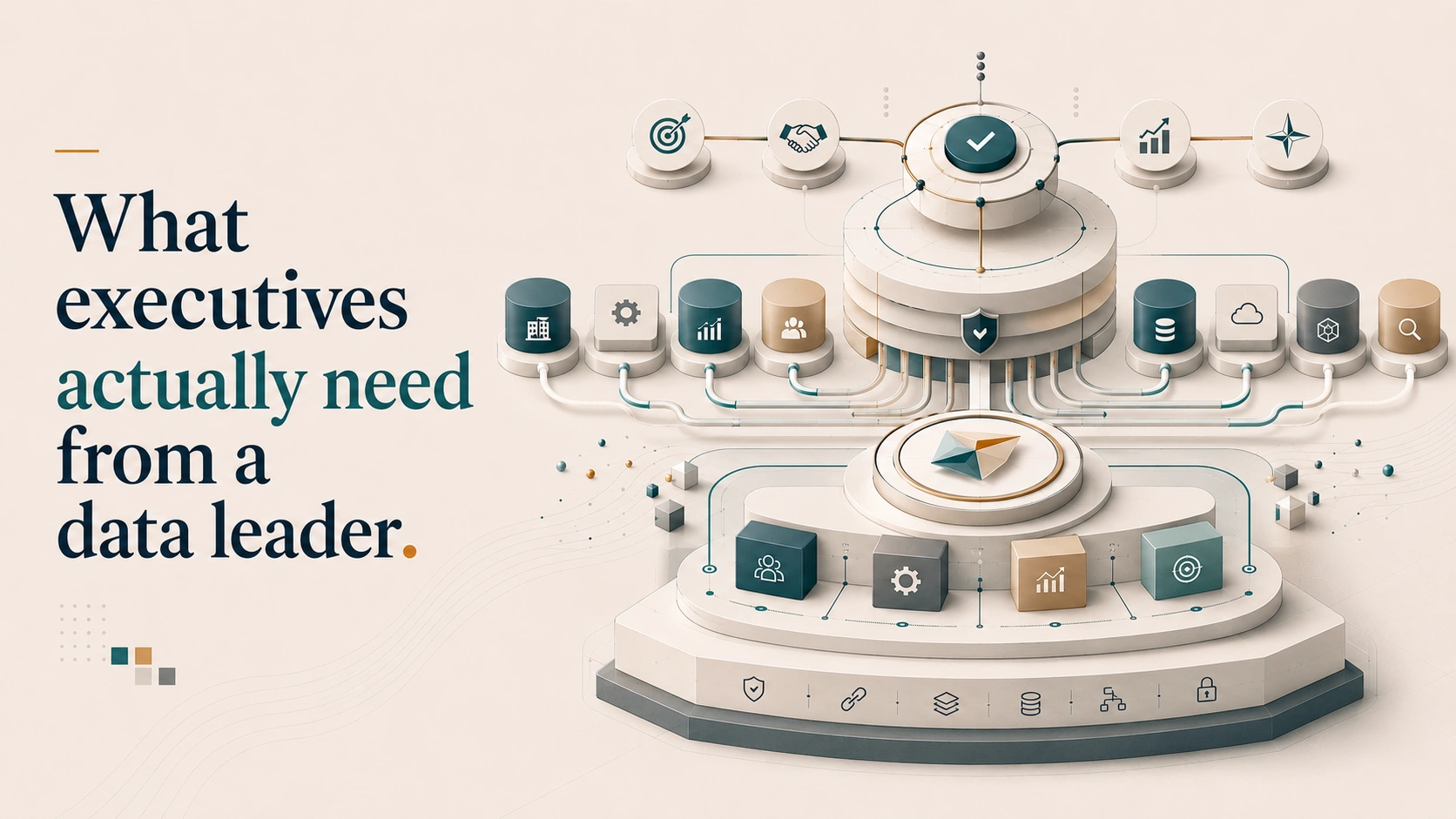
Organisations keep hiring for "data leadership" and then wondering why the results feel underwhelming. The dashboards ship. The pipelines run. The team is busy. But the executive conversation hasn't changed. Decisions still default to intuition. Definitions still conflict across teams. And the data leader ends up chairing meetings about metadata while the real strategic questions get answered somewhere else.
I've seen this pattern enough times to believe the problem isn't talent or effort. It's a mismatch between what many data leaders focus on and what executives actually need. The gap isn't about technical depth. It's about organisational leverage.
What executives usually don't need
More dashboards by default. A longer tool shopping list. Jargon-heavy architecture presentations that explain how the lakehouse works but not what it enables. Disconnected AI experimentation with no operating model behind it. Data work that looks busy but is hard to connect to outcomes anyone at the executive table cares about.
These aren't bad things in isolation. Dashboards are useful. Tools matter. Architecture decisions have real consequences. But when they become the primary output of a data leader's mandate, they create activity without leverage. And executives notice. They may not say it directly, but they feel it - the data team is doing a lot, and somehow nothing at the top is getting easier.
What executives actually need
The executives I've worked with and observed tend to want a small number of hard things from a data leader. They rarely articulate them as a list, but the pattern is consistent.
Trust. Can I believe the numbers? Are the definitions consistent? When I make a decision based on this data, will it hold up? Trust is the foundation. Without it, everything else is decorative. I've seen organisations where the same metric shows three different values in three different systems, and the executive response isn't "build more dashboards" - it's "I don't trust any of this." Rebuilding trust is slower and less glamorous than building a new pipeline, but it's the work that actually matters.
Focus. Are we working on the things that move the business, or are we responding to whoever asked last? Executives want a data leader who can tie the team's priorities to business goals and hold the line when the request queue pulls in every direction. That means saying no to work that doesn't connect to outcomes, even when the request comes from someone senior.
Translation. Can this leader explain what the data team does in terms I care about - risk, cost, speed, revenue - rather than in terms of pipelines, models, and stack components? The ability to connect technical work to executive language isn't a soft skill. It's a structural requirement for influence. If the data leader can't translate, the executive can't evaluate, and the work gets deprioritised.
Delivery. Not activity. Delivery. Can this leader turn strategy into usable capabilities and visible progress? Can they ship something that changes how a team operates, not just what they see on a screen? Executives track whether things are getting better, not whether the team is busy.
Leverage. Are we building systems, standards, and operating models that scale beyond individual heroics? Or does every new request require a custom solution from the same three people? Leverage is what separates a data team that compounds over time from one that runs faster but stays in place.
Governance. Not bureaucracy. Enough structure to create trust and accountability - clear ownership, consistent definitions, auditable lineage - without burying teams in process. Governance that slows decisions isn't governance. It's overhead wearing a different name.
Judgment. Knowing where to invest, where to simplify, and what not to do. This might be the most undervalued capability. The data leader who can say "we should not build this" or "this metric isn't worth the cost of maintaining it" is more valuable than the one who says yes to everything and delivers half of it poorly.
Why this is often misunderstood
Many data leaders are rewarded for technical sophistication more than organisational leverage. The team that builds an elegant streaming architecture gets praised. The team that simplifies a metric definition so three departments finally agree on revenue doesn't get the same recognition - even though the second creates more business value.
Some teams optimise for output volume instead of decision impact. They count dashboards shipped, pipelines deployed, and tickets closed. These are easy to measure. But they don't answer the question executives actually care about - are we making better decisions faster because of this work?
There's also a visibility gap. Executives see the polished outputs - the dashboards, the reports, the AI demos. They don't see the broken pipelines, the conflicting definitions, the alerts that go unheeded. Research consistently shows that C-level leaders have more confidence in their data maturity than the directors and VPs who actually operate the systems. This isn't because executives are naive. It's because the information they receive is filtered through layers of aggregation that hide the operational reality.
The result is a persistent disconnect - data teams celebrate technical milestones while executives wonder why nothing at the top feels different.
What strong data leaders do differently
The data leaders I've seen create real executive impact share a few patterns.
They build trust before demanding adoption. They don't ask the organisation to "become data-driven" while the numbers are still unreliable. They fix the foundations first - consistent definitions, clear ownership, auditable lineage - and then invite people to use what they can actually depend on.
They simplify metrics and ownership. Instead of tracking forty KPIs across five dashboards, they identify the handful that actually drive decisions and make sure those are trustworthy, owned, and current. They know that a metric nobody acts on isn't a metric. It's decoration.
They create alignment across functions. When marketing and finance define "customer" differently, the data leader doesn't just document the discrepancy. They facilitate a resolution. This is unglamorous work, but it's the kind that removes friction from every downstream decision.
They make trade-offs explicit. When the team can't do everything, they surface the choice - "We can deliver this new use case, or we can stabilise the pipeline that feeds the board deck. Which matters more right now?" This kind of clarity is more valuable than a plan that pretends everything is possible.
They prioritise ruthlessly. Not everything that can be measured should be measured. Not every AI pilot should move forward. Strong data leaders kill work that doesn't connect to outcomes, even when it's technically interesting.
They invest in foundations that compound. Shared pipelines, reusable data products, standardised patterns - these aren't exciting, but they're what allow the tenth use case to cost a fraction of the first. Without them, every new request starts from scratch.
They explain data strategy in terms of business capability, not architecture. They don't say "we're implementing a data mesh." They say "we're making it possible for each team to own and serve their own data products, which reduces bottlenecks and speeds up delivery." Same work. Different language. One creates executive buy-in. The other creates executive glaze.
A practical executive lens
If you're an executive evaluating a data leader - or a data leader evaluating yourself - here are the questions that actually matter:
- Can I trust the numbers? Not "are they technically accurate." Can I make a decision based on them and not have to second-guess it next week?
- Are we getting faster or slower at making decisions? Is the data organisation reducing the time from question to answer, or adding steps and reviews that slow things down?
- Are teams aligned on definitions and priorities? When three departments look at the same metric, do they see the same number? Or do they each have their own version and argue about which one is right?
- Are we building reusable capabilities or repeating custom work? Does the fifth use case take less effort than the first, or are we still doing tailored solution every time?
- Is the data organisation reducing complexity or adding it? Are we consolidating tools, simplifying ownership, and removing friction? Or are we adding another layer of systems that nobody fully understands?
- Is AI being adopted responsibly and usefully, or just discussed? Are there AI capabilities in production that change how people work? Or are we still at the pilot stage with no clear path to operational impact?
- Does this leader bring clarity, or more abstraction? After a conversation with the data leader, does the executive team understand what's happening and what to expect? Or do they feel like they sat through a technical briefing that didn't connect to anything they're accountable for?
My point of view
I've spent enough time at the intersection of data platforms and executive expectations to believe that the best data leaders are not just technical experts. They are builders of trust, leverage, and organisational clarity. The role is as much about shaping operating systems and decision environments as it is about pipelines and platforms.
The data leader who only speaks in technical terms will have influence within the data team but limited reach beyond it. The one who can connect a pipeline investment to a decision speed improvement, a governance standard to a risk reduction, or a platform simplification to a cost saving - that leader gets invited into the conversations where strategy is actually made.
I don't think this means data leaders should become generic business consultants. The technical depth matters. You can't create trust in data without understanding how it moves through systems. You can't build leverage without knowing what good architecture looks like. You can't make sound judgments about what to simplify if you don't understand the complexity underneath. The point isn't to abandon technical depth. It's to recognise that technical depth alone doesn't create executive value. It has to be directed toward the right outcomes, communicated in the right language, and organised to compound over time.
The organisations that get this right don't just have better data teams. They have better decision-making cultures. The data leader's job is to build the conditions for that - not to own every dashboard, but to make sure the organisation can trust what it sees, act on what it knows, and improve how it decides.
In short
Executives don't need a data leader who simply knows the stack. They need one who can turn data into trust, decisions, and scalable organisational leverage. That means building foundations before chasing features, choosing clarity over complexity, and measuring impact by what changes at the decision level - not by what ships at the delivery level. The data leaders who last are the ones who make the organisation better at deciding, not just better at reporting.