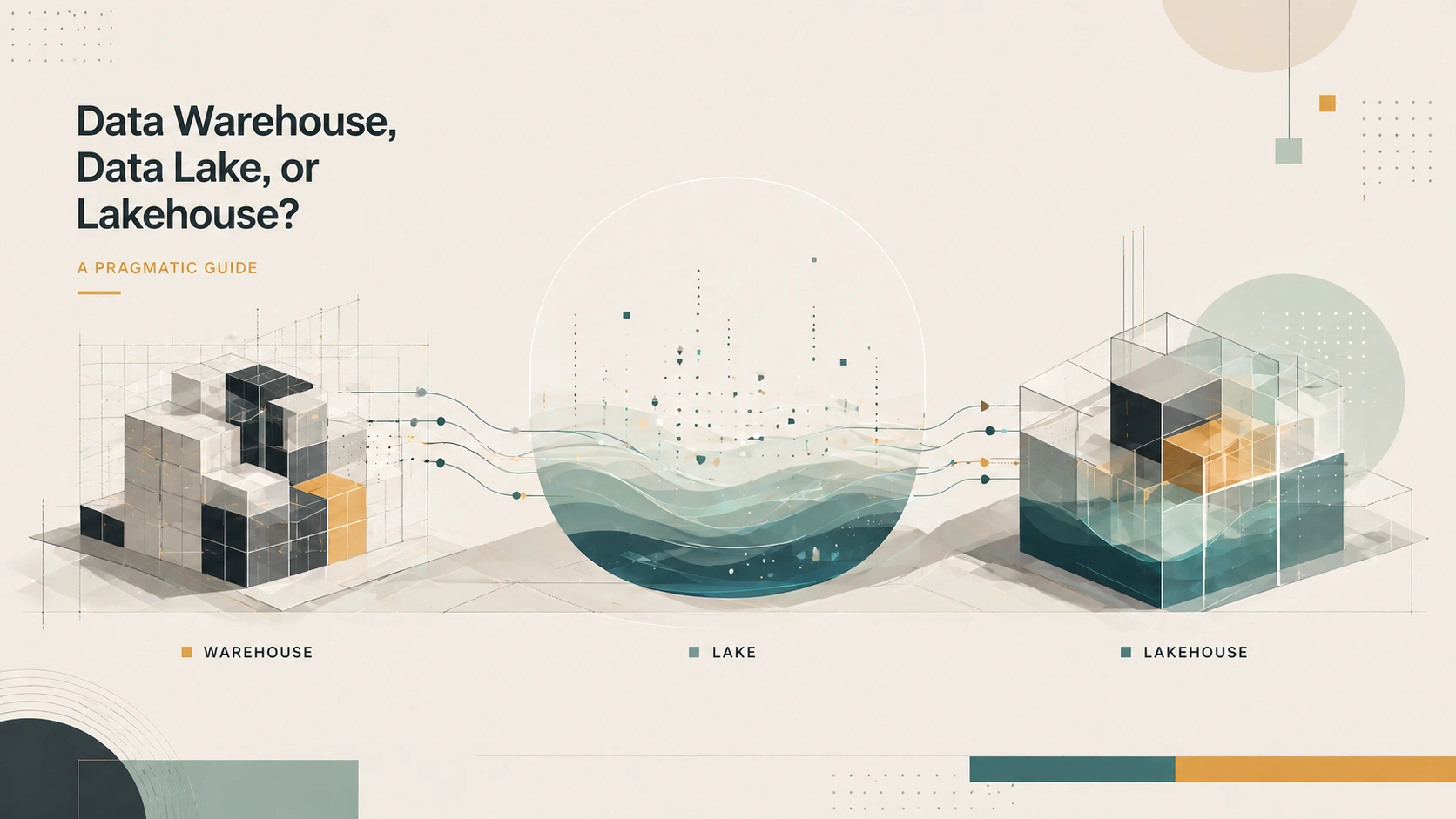
Most data teams spend more time debating architecture patterns than clarifying what they actually need. The conversation usually starts with "should we use a data warehouse or a data lake?" and quickly devolves into vendor comparisons and technology preferences. The real question should be: what workloads are you trying to support, and what operating model can your team sustain?
Architecture should follow business needs, not trends. A data warehouse, data lake, and lakehouse each solve different problems. Understanding their trade-offs helps you avoid over-engineering, under-investing, or building something your team cannot operate effectively.
Data Warehouse: Structured, governed, BI-first
Data warehouses emerged in the 1980s to solve a specific problem: bring structured data from transactional systems into a single repository optimised for analytics and reporting. The defining characteristic is schema-on-write - data is structured, cleaned, and transformed before it enters the warehouse.
This approach delivers predictable performance and strong governance. Because schemas are defined upfront, queries are fast and reliable. Data quality checks happen during ingestion, so downstream users can trust what they find. This makes warehouses ideal for business intelligence dashboards, operational reporting, and any use case where consistency matters more than flexibility.
The trade-off is cost and rigidity. Warehouses typically use columnar storage and proprietary formats optimised for analytical queries. Storage and compute are often bundled, which means you pay for performance even when you are not using it. Adding new data sources requires schema design and ETL work, which slows down experimentation. If your primary workloads are BI dashboards and structured reporting, a warehouse is often the right choice.
Data Lake: Flexible, scalable, experimentation-friendly
Data lakes arrived in the early 2010s to handle a different problem: the explosion of unstructured and semi-structured data from web applications, IoT devices, and social media. The defining characteristic is schema-on-read - data is stored in its raw format and structured only when accessed.
This approach delivers flexibility and cost efficiency. You can ingest data quickly without worrying about schema design or transformation logic. Cloud object storage like Amazon S3, Google Cloud Storage, or Azure Blob Storage provides virtually unlimited capacity at low cost. Data scientists and ML engineers can explore raw data, build features, and train models without waiting for data engineering teams to build pipelines.
The trade-off is governance and performance. Without strong discipline, data lakes become data swamps - messy repositories where no one can find anything or trust what they find. Query performance varies widely depending on how data is organised and what engines you use. Access controls and data quality are often bolted on rather than built in. If your primary workloads involve ML experimentation, raw data storage, or diverse data types, a lake is often the right choice.
Lakehouse: Hybrid, unified, complexity-aware
Lakehouses emerged in the late 2010s to address a practical reality: most organisations need both warehouse and lake capabilities. The defining characteristic is a unified platform that combines low-cost storage with warehouse-style analytics features like ACID transactions, schema enforcement, and optimised query engines.
This approach delivers the best of both worlds when implemented well. You can store raw data in open formats like Parquet or Delta Lake, then layer tables with schemas, constraints, and performance optimisations on top. Data scientists can work with raw data while BI teams query curated tables - all without moving data between systems. Modern lakehouse platforms like Databricks, Snowflake, and BigQuery have made this pattern increasingly accessible.
The trade-off is complexity. Lakehouses require teams to understand storage formats, table formats, query engines, and governance layers. The medallion architecture - bronze for raw data, silver for cleansed data, gold for business-ready data - adds operational overhead. If your team lacks the maturity to manage this complexity, a lakehouse can become more expensive and harder to operate than simpler alternatives. If you have mixed workloads and a capable team, a lakehouse is often the right choice.
The right architecture depends on your workloads, data types, governance requirements, and team maturity - not on what is trending or what vendors are selling.
Comparison: What fits where
| Dimension | Data Warehouse | Data Lake | Lakehouse |
|---|---|---|---|
| Data Types | Structured only | Structured, semi-structured, unstructured | All types with structured tables on top |
| Schema Approach | Schema-on-write | Schema-on-read | Both, with enforcement on curated tables |
| Governance | Built-in, strong | Bolt-on, requires discipline | Built-in, with catalog and lineage |
| Performance | High for BI queries | Variable, depends on organisation | High for BI, good for ML workloads |
| Cost Profile | Higher, bundled compute/storage | Low storage, compute separate | Low storage, compute separate |
| Best-fit Workloads | BI dashboards, operational reporting | ML experimentation, raw data storage | Mixed BI and ML, unified platform |
| Team Complexity | Lower, well-understood patterns | Moderate, requires governance discipline | Higher, requires multi-layer understanding |
When to choose what
The decision framework starts with your workloads. If 80% of your use cases are BI dashboards and operational reporting, a data warehouse is likely sufficient. The performance and governance benefits outweigh the cost premium, and your team can focus on building reliable pipelines rather than managing a complex platform.
If your primary workloads involve machine learning, data science, or experimentation with diverse data types, a data lake is likely necessary. The flexibility to ingest raw data quickly and explore it without schema constraints accelerates innovation. Just invest in governance early to avoid the data swamp problem.
If you have significant workloads in both categories and a team capable of managing complexity, a lakehouse is worth considering. The unified platform eliminates data movement between systems and provides a single source of truth. But be honest about your team's maturity - if you are still building foundational data engineering capabilities, starting with a simpler pattern and evolving toward a lakehouse may be more practical.
Common mistakes and misconceptions
The most common mistake is choosing architecture based on hype rather than needs. Teams adopt lakehouses because they are modern, then struggle with the operational complexity. Others stick with warehouses because they are familiar, then cannot support ML workloads. The right choice depends on what you are trying to build, not what is trending.
Another mistake is ignoring the operating model. A lakehouse requires different skills and processes than a warehouse or lake. If your team is not ready to manage multi-layer data quality, schema evolution, and performance tuning, the architecture will fail regardless of its theoretical benefits. Start with what your team can operate effectively, then evolve as capabilities grow.
Finally, avoid over-engineering for future needs. Many teams build lakehouses anticipating workloads that never materialise. Start simple, validate assumptions, and scale complexity only when justified by actual requirements. Architecture should enable your workloads, not become a project in itself.
In short
- Data warehouses excel at structured, governed BI workloads with predictable performance.
- Data lakes excel at flexible, scalable storage for ML experimentation and diverse data types.
- Lakehouses combine both approaches but require team maturity to operate effectively.
- Choose based on workloads, governance needs, and team capability - not trends.
- Start simple, validate assumptions, and evolve complexity as needed.
Architecture is a means to an end, not the end itself. The right pattern is the one that enables your team to deliver value reliably and sustainably.