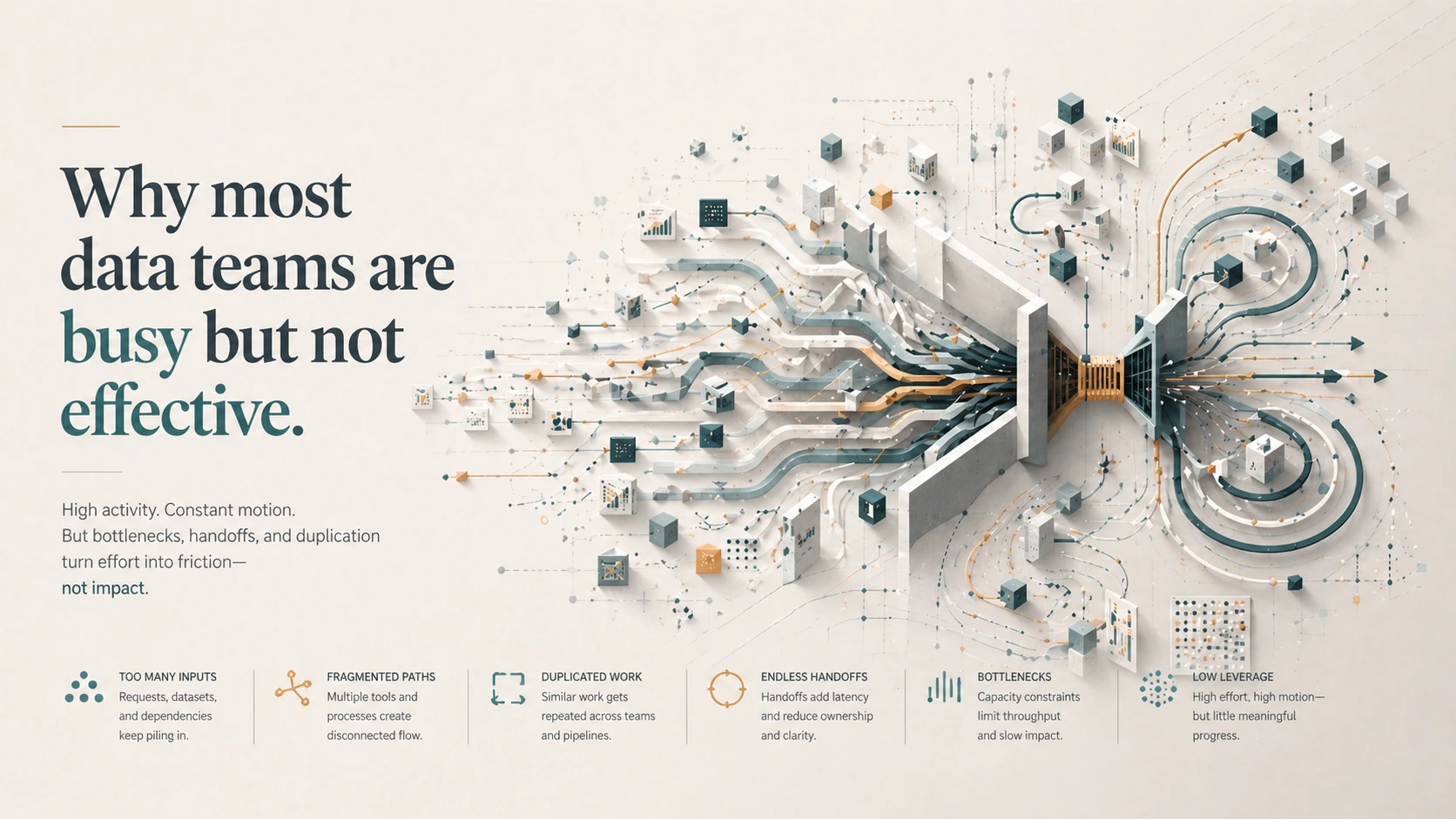
I have seen data teams drowning in requests while barely moving the needle. They ship dashboards, fix pipelines, respond to ad hoc queries, and attend endless stakeholder meetings. By all visible measures, they are productive. Yet the business still struggles to make data-driven decisions, trust in data remains low, and the team feels perpetually behind.
The problem is not effort. The problem is a system designed for activity rather than leverage. Busyness is not the same as effectiveness.
What "busy but not effective" looks like
You know the pattern. The team ships 47 dashboards last quarter, but only three are used weekly. They respond to hundreds of ad hoc requests, but most are one-off analyses that never get reused. They spend half their time fixing broken pipelines and reconciling conflicting metric definitions. Stakeholders keep asking for the same data in slightly different formats because they cannot find what they need or do not trust what exists.
The team is visibly responsive. They are always working. But they are not building leverage. Every request is treated as a new project rather than an opportunity to improve the system. The work compounds for the team but not for the business.
Why this happens
This pattern emerges from several structural problems that reinforce each other.
The most common culprit is a reactive intake model. Data teams operate as ticket-taking service desks, processing whatever requests come in without clear prioritisation or strategic framing. When everything is a priority, nothing is. The team says yes to everything because saying no feels like failing to support the business, even though saying yes to low-value work is what actually fails the business.
Weak prioritisation compounds this problem. Without clear frameworks for evaluating what matters, the team defaults to responding to whoever shouts loudest or has the most political capital. Strategic initiatives that could create lasting value get pushed aside by urgent but unimportant requests.
Trust issues create a vicious cycle. When stakeholders cannot trust the data, they request custom analyses to verify everything. When the team cannot trust their own foundations, they spend excessive time on quality checks and firefighting. Low trust increases demand for ad hoc work, which reduces capacity for building trusted systems, which further erodes trust.
Poor platform foundations create constant operational drag. When basic data quality, documentation, and reliability are missing, every new request requires significant detective work and cleanup. The team cannot move fast because they are constantly tripping over their own infrastructure.
Fragmented ownership makes accountability impossible. No one is clear on who owns metric definitions, who owns data quality, who owns documentation, or who owns stakeholder relationships. Everything becomes everyone's problem, which means no one is responsible for anything specific.
Finally, success is measured by output volume rather than decision impact. Teams track dashboards shipped, tickets closed, and pipelines built rather than whether business decisions are being made faster, more confidently, and with better outcomes.
The common traps
Many data teams fall into predictable patterns that keep them stuck in reactive mode.
The reporting factory trap is the most common. The team becomes a dashboard production line, churning out visualisations without understanding the decisions they are meant to support. Dashboards are built because someone asked for them, not because they solve a specific business problem. The team optimises for dashboard volume rather than decision quality.
Chasing tooling instead of solving flow problems is another trap. Teams adopt new tools hoping they will magically fix operational issues, but the real problems are in their processes, ownership models, and stakeholder alignment. A lakehouse will not help if you cannot agree on what a customer is.
Overengineering for scale while basics are broken is surprisingly common. I have seen teams building complex real-time streaming architectures when they cannot even get their batch data quality right. They optimise for future scale while current workloads are unreliable and slow.
Governance treated as paperwork instead of operational clarity creates unnecessary friction. When governance is about compliance checklists rather than shared understanding, teams either ignore it or get bogged down in bureaucracy. Effective governance is about operational clarity, clear definitions, documented processes, and agreed-upon standards that make work easier, not harder.
Confusing stakeholder noise with strategic priority is the final trap. Loud stakeholders with urgent requests often get priority over quiet but important initiatives. The team optimises for responsiveness rather than impact.
What effective data teams do differently
Effective data teams operate differently. They build systems that compound rather than work that repeats.
They invest in trusted foundations first. Before building complex analytics, they ensure basic data quality, clear metric definitions, and reliable pipelines. They understand that speed without trust is useless, so they prioritise reliability and clarity over feature velocity.
They define clear ownership boundaries. Everyone knows who owns what - metric definitions, data quality, documentation, stakeholder relationships. Clear ownership creates accountability and reduces the endless debates about who should do what.
They reduce repeated ad hoc work through automation and self-service. When the same request comes in three times, they build a reusable solution rather than answering it three times. They invest in documentation, training, and tools that enable stakeholders to answer their own questions.
They create reusable data products and common definitions. Instead of building one-off analyses, they build curated datasets, standardised metrics, and documented APIs that can be reused across the organisation. They treat data as a product with clear owners, users, and success metrics.
They prioritise ruthlessly. They have clear frameworks for evaluating requests and are willing to say no to low-value work. They understand that every yes to something unimportant is a no to something important. They protect capacity for high-impact initiatives.
They improve developer experience and delivery flow. They understand that friction in the development process slows everything down, so they invest in tooling, automation, and processes that make it easy to do the right thing. They measure and optimise time-to-insight, not just time-to-ship.
They measure success by adoption, trust, speed, and business decisions enabled. They track whether stakeholders are using their outputs, whether they trust the data, how fast decisions are being made, and whether those decisions are leading to better outcomes. They optimise for impact, not activity.
A practical framework
Assess your team across these dimensions to understand where you are stuck:
Trust: Do stakeholders believe the data? Can they rely on it for critical decisions? Low trust indicates foundational issues that must be addressed before anything else.
Focus: Are you working on the right things? Do you have clear priorities and the ability to say no to low-value requests? Poor focus indicates weak prioritisation and strategic alignment.
Reuse: How much work compounds? Are you building reusable foundations or repeating the same work? Low reuse indicates a reactive, ticket-taking model.
Time to insight: How fast can decisions be made? From question to answer, how long does it take? Slow time-to-insight indicates platform friction and poor developer experience.
Platform friction: How hard is it to deliver? Do basic tasks require excessive effort? High friction indicates poor foundations and tooling choices.
Stakeholder alignment: Are expectations clear? Do stakeholders understand what the team does and does not do? Poor alignment indicates weak communication and unclear ownership.
Effectiveness comes from system design, not heroics. The goal is not to make data teams work harder, but to make their work compound.
In short
- Busyness is not effectiveness. Activity does not equal leverage.
- Reactive intake models, weak prioritisation, and low trust create vicious cycles.
- Effective teams build trusted foundations, clear ownership, and reusable systems.
- Measure success by adoption, trust, speed, and decisions enabled - not output volume.
- The goal is making work compound, not working harder.