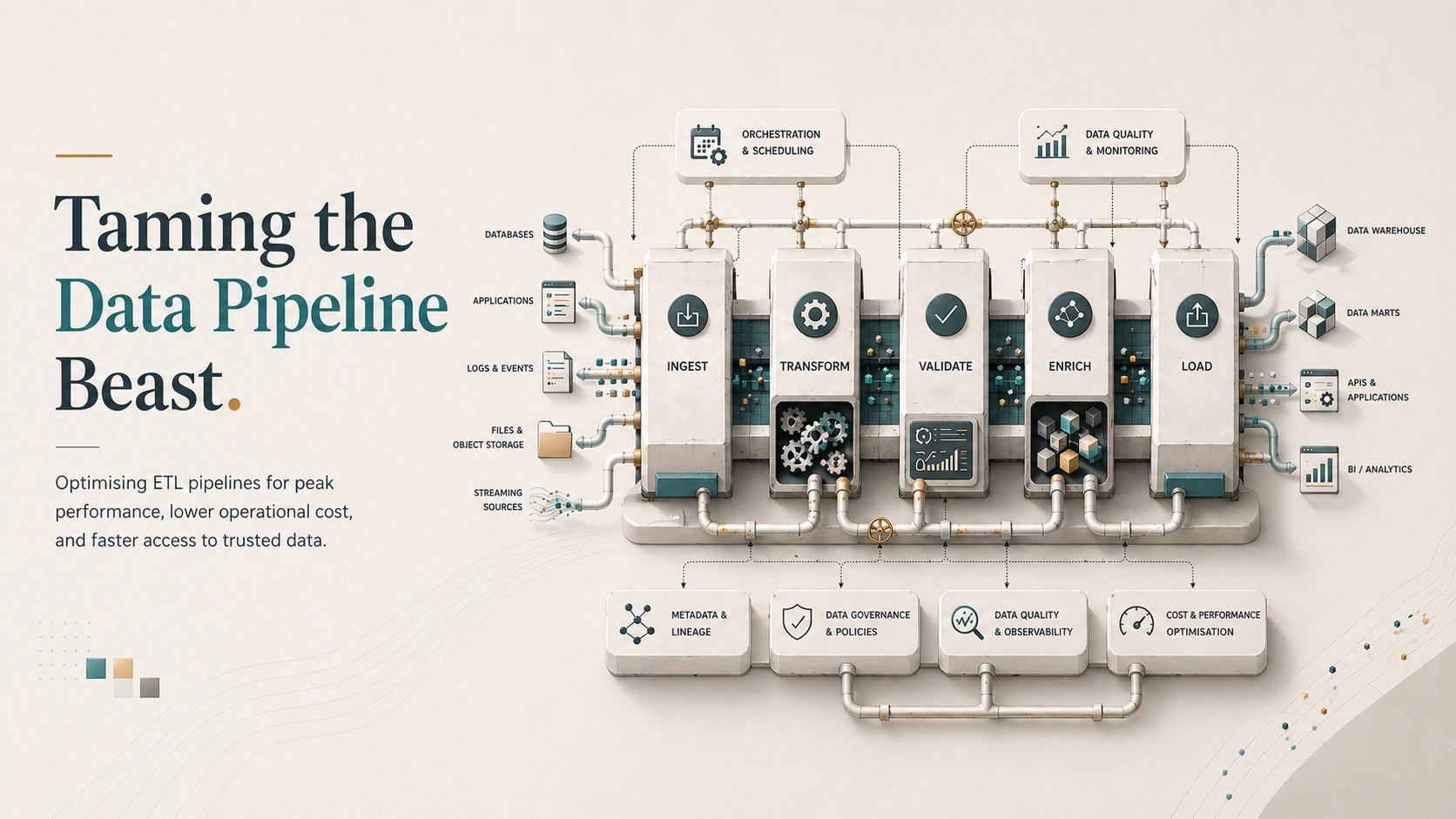
A crucial aspect of data engineering is optimising ETL pipelines for better performance. Efficient pipelines make data available faster, reduce infrastructure cost, and improve the quality of business decisions.
Optimising ETL pipelines is an ongoing operating discipline. The goal is not just speed, but dependable data flow that teams can trust.
What is ETL?
ETL stands for Extract, Transform, Load. It is the process of extracting data from source systems, transforming it into useful structures, and loading it into destinations such as databases, warehouses, or analytical platforms.
- Extracting data from various sources.
- Transforming it into a suitable format.
- Loading it into a destination such as a database or data warehouse.
Optimising these steps is vital to ensure that data is accurate, timely, and useful for analysis.
Key optimisation strategies
Identify the bottlenecks
ETL pipelines can have weak points that slow everything down. Profiling tools help pinpoint whether the problem is inefficient queries, excessive data movement, resource limits, or poor orchestration.
Embrace parallel processing
Tasks that can run concurrently should not wait in a single lane. Parallel processing can significantly reduce total processing time when the workload is designed for it.
Leverage partitioning
Partitioning large tables into smaller, manageable chunks allows faster querying and data manipulation. This is especially important for high-volume tables with predictable access patterns.
Optimise SQL deliberately
Well-written SQL is still one of the strongest levers for efficient transformation. Use indexes, proper filtering, column selection, and optimised join patterns to avoid unnecessary work.
Cache where it earns its keep
Frequently accessed data can be cached to avoid repeated computation and retrieval. Caching is especially useful for repetitive transformations, reporting layers, and downstream analytical workloads.
Monitor and refine
Complex pipelines need monitoring. Track runtime, cost, freshness, failure patterns, data quality, and resource usage so improvement work is guided by evidence.
Use incremental loads
Instead of reloading all data every time, update only what has changed. Incremental processing reduces load time, resource usage, and failure blast radius.
Make transformations efficient
Minimise complex operations, use efficient algorithms, and pre-compute aggregations when possible. The best transformation logic is clear, testable, and operationally predictable.
Manage resources
Monitor CPU, memory, and I/O usage. Pipelines should be tuned so they do not overload systems or create noisy-neighbour problems for adjacent workloads.
Essential tools
ETL and ELT tools
The ETL landscape keeps evolving. Frameworks such as Airbyte, dbt, and Stitch can support modular development, cloud-native execution, and more streamlined pipeline delivery.
Workflow orchestration
Use orchestration tools such as Apache Airflow, Prefect, and Dagster to schedule, monitor, and manage ETL tasks reliably.
Monitoring and logging
Tools such as Prometheus, Grafana, and the ELK stack help teams understand performance, detect bottlenecks, and respond quickly when pipelines drift from expected behaviour.
Conclusion
By implementing these optimisation strategies, data teams can turn slow pipelines into high-performance systems. Efficient ETL processes save time and resources while ensuring the organisation has access to accurate, timely data for critical decisions.
Optimisation is not a one-time project. Regularly revisiting and refining ETL pipelines helps data platforms keep pace with changing business needs and growing data volume.
In short
Robust data pipelines need clear design, observability, incremental processing, and continuous optimisation - not just more tooling. Treat pipelines as production systems with monitoring, testing, and maintainability built in from the start, and revisit them as data volume and business needs evolve.